7 Zapier MCP alternatives I'd consider in 2026
What Zapier MCP gives you on each plan and what a call costs in tasks, then seven alternatives for putting your AI to work in your apps: n8n, Make, Activepieces, Gumloop, Composio, Pipedream and FloConnector.

I’m a Zapier fan, and I’ll say that up front because this is a page about leaving it.
My first automation wasn’t even Zapier. It was IFTTT, nearly ten years ago. I had a Raspberry Pi camera running an image-detection model, and when it spotted something it fired an HTTP request at an IFTTT webhook, which sent me an email. I thought it was the coolest thing I’d ever built. Not long after, I found Zapier, and it’s been the market leader for that kind of work ever since: a trigger, a fixed set of steps, the same result every time.
That’s deterministic automation, and it’s still the right tool for plenty of jobs. But the work has changed. Now I want Claude or ChatGPT to do the job itself: read the invoices, find the overdue ones, draft the follow-ups. Zapier saw that too, and Zapier MCP is its answer. It’s a good one. It’s also not the only one, and depending on what you need, it isn’t always the cheapest or the deepest.
So here’s what Zapier MCP gives you, fairly, and then seven alternatives. I run  FloConnector, which is one of them, so read it knowing that. Every fact about the others comes from their own pricing, docs and security pages, checked on 26 November 2026. Where a vendor doesn’t publish something, I say so rather than guess.
The short answer
FloConnector120+ business apps on one URL, deeper tools per app, and you pick what each person's AI can do. From 1¢ a call.
If you want to host it yourself n8n
Pick which workflows your AI can run, host it yourself for free, and try Nod, its new open-source agent.
If you want open source Activepieces
An MIT-licensed core, 778 apps, and most MCP calls cost nothing.
If you already build in Make Make
MCP is free on every plan. Your AI runs your scenarios, and you can mark each one read-only.
What Zapier MCP gives you
Before any alternative, the thing itself. Zapier MCP connects your AI client to Zapier’s actions. You add it in Claude or ChatGPT, sign in to Zapier, and your AI can search, create and update records in the apps you’ve already connected to Zapier. There’s no server to set up: Zapier builds one for you when you first sign in.
It works in Claude on every Claude plan, the free one included, and Zapier is in Claude’s connectors directory. In ChatGPT you need Plus or Pro to add it yourself, or a Business, Enterprise or Edu workspace that already has it (Zapier’s ChatGPT guide).
Agentic mode and managed mode
Zapier gives you two ways to run a server:
- Agentic mode is the default. Your AI gets 16 fixed tools for finding, switching on and running Zapier actions as it goes, rather than thousands of tools loaded up front. It’s the sensible design for a catalog that size.
- Managed mode is for a fixed, predictable set. You choose the actions at mcp.zapier.com, each becomes its own tool, and the AI can’t add more.
In both modes you can lock a field to a set value, so the AI can’t change, say, which account an invoice goes to.
Zapier's own video: a hiring plan built with Zapier MCP and Claude (Zapier Academy, 23 November 2026).
What it costs
Zapier MCP is included on every plan. Calls come out of the same task allowance as your Zaps: a successful call normally uses 2 tasks, a failed one uses none, and a batch call (one call that adds 100 rows) is billed once (rate card, usage). From 23 November 2026 to 5 January 2027, successful calls use no tasks at all.
| Plan | Billed yearly | Billed monthly | Tasks a month | MCP calls a month | Per call |
|---|---|---|---|---|---|
| Free | $0 | $0 | 100 | 50 | $0 |
| Professional | $19.99 a month | $29.99 | 750 | 375 | about 5.3¢ |
| Professional, 10K | $129 a month | $193.50 | 10,000 | 5,000 | about 2.6¢ |
| Team | $69 a month | $103.50 | 2,000 | 1,000 | about 6.9¢ |
| Enterprise | Contact sales | Contact sales | Custom | Custom | Not published |
Swipe to see every column →
The plans differ in more than tasks. Free runs two-step Zaps only. Professional adds multi-step Zaps and premium apps. Sharing an MCP server with your team, the audit log and SAML single sign-on start on Team. Controls over which apps and actions people can use are Enterprise only, and they apply to your whole account, not to MCP alone (security).
Deterministic and agentic, both at Zapier
Zapier now runs on what it calls “a spectrum from pure determinism to full inference”, and it prices each part differently:
- Zaps
A trigger, then fixed steps in a fixed order. No AI.
1 task per action - AI by Zapier
An AI step inside a Zap that can use tools.
tasks × 1, 3 or 5 - Zapier Agents
Standalone agents, now folding into AI by Zapier.
400 activities free - Zapier MCP
Your own AI, in Claude or ChatGPT, calling Zapier actions.
2 tasks a call
Where Zapier MCP shines
 G2
 Capterra
 Trustpilot
Breadth and ease. 9,000+ apps, nothing to build, a sign-in from inside Claude, and the apps you’ve already connected to Zapier show up on their own. It’s SOC 2 Type II and SOC 3 certified, and it has more reviews than everything else here put together. If you already live in Zapier, it’s the obvious place to start.
What to look for in a Zapier MCP alternative
People leave for a handful of reasons, so these are the things I compared:
- What your AI actually gets. Some tools give it app actions it can call directly. Others give it the workflows you’ve built. Both work, but they’re different jobs: one needs building first.
- How deep each app goes. A count of apps says little. What matters is whether the AI can do the specific thing you need in Xero or HubSpot, read and write.
- What a call costs. Tasks, credits, executions and calls aren’t the same unit. Work out the cost of one call from your AI, at the volume you’ll run.
- How your AI signs in. OAuth (a sign-in page) beats pasting a token, and it matters more once a team is involved.
- Control. Can you choose which tools each person’s AI gets, and keep reads apart from writes?
- Self-hosting and certifications, if your industry asks for either.
7 Zapier MCP alternatives
FloConnector
Built for a business putting its own apps in its own AI, with deeper tools per app and control over what each person's AI can do.
- Apps
- 120+
- AI signs in
- OAuth 2.1
- Billed by
- 1¢ a call
- From
- $0, Solowith 1,500 free credits
Where it beats Zapier
- Deeper per app: 133 Xero tools against the 38 Xero actions I counted on Zapier's Xero page.
- Big reads stay out of the chat: load the rows, ask the question, get the answer back.
- Tool governance: choose the tools each person's AI gets, reads apart from writes.
- Tables, Skills and Media the AI keeps between chats.
Where Zapier still wins
- 120+ apps, not 9,000+.
- No Zaps: FloConnector is for your AI, not for scheduled automations.
- No SOC 2 yet. Our DPA says so plainly.
- No self-hosting.
FloConnector is a different kind of product from the rest of this list. It isn’t an automation builder and it doesn’t run its own AI. It’s the back end for the AI you already use: one URL that carries your apps, signed in with each app’s own login, plus the pieces an AI needs to do a business’s work properly. It works the same in Claude, ChatGPT and the other AI apps.
- Seven tools, the whole catalog
Your AI sees seven fixed tools, one of them for drawing charts, and searches for the rest, so hundreds of tools never crowd its context.
- Load, then query
A big read goes into a temporary analytics workspace. Only the answer comes back to the chat.
- Tool governance
Profiles decide which tools each person's AI gets, tool by tool, with reads kept apart from writes.
- Tables
Structured records your AI keeps between chats, and you can edit in a grid.
- Skills
Your way of doing a job, written once and used by every chat.
- Media
Files your AI moves between apps, kept so you can find them again.
- Connect links
Send a client a link and they connect their own account, without sharing a password.
- Activity log
Every call recorded on every plan, as metadata, never the contents.
It was agent-first from the start, and that shows in how you can run it. There are two kinds of MCP:
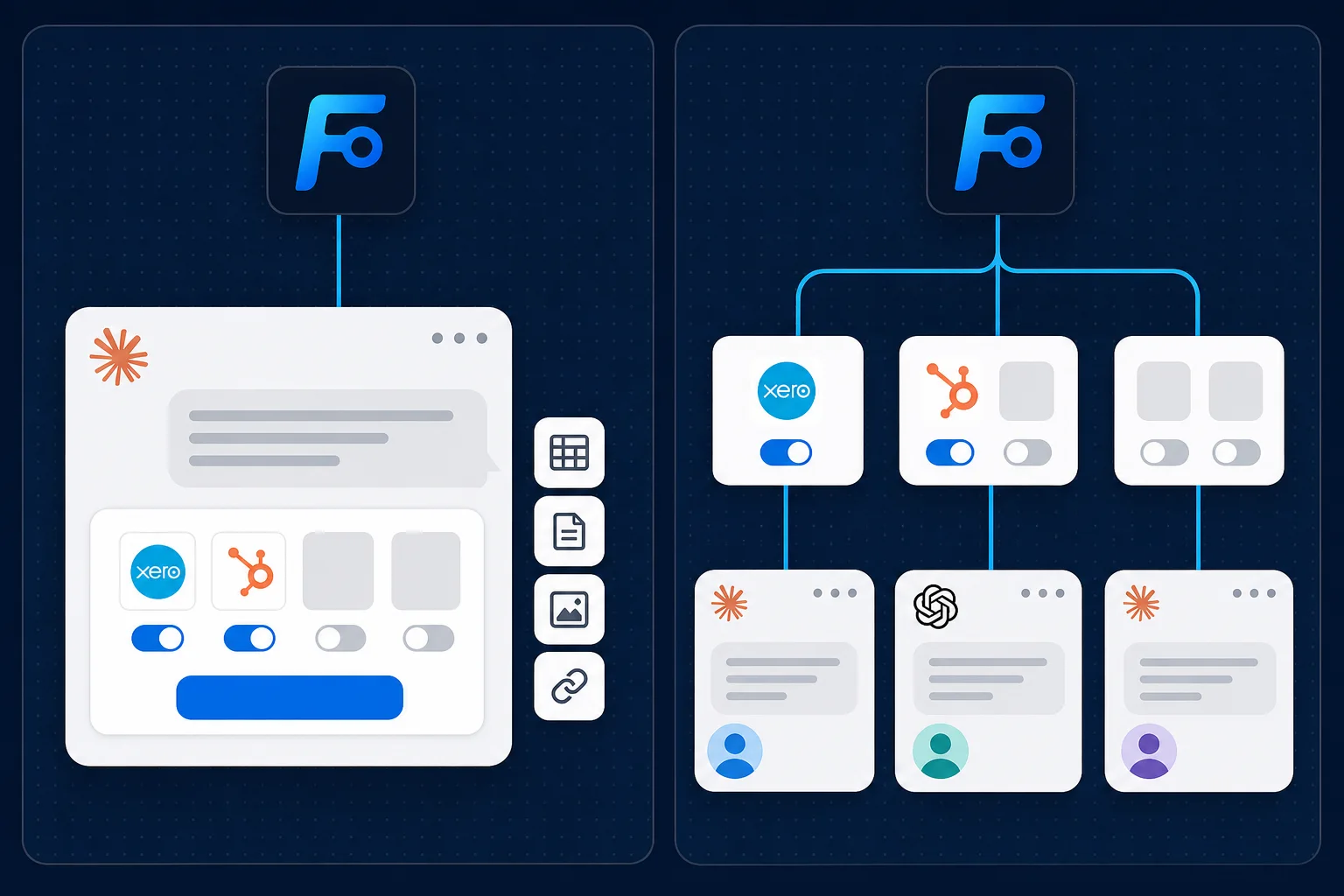
One chat runs the platform: sign up, connect apps, switch tools on, manage Tables, Skills, Media and connect links. How it works
Each person's AI gets only the apps and tools their profile switches on, in Claude, ChatGPT or any other AI app.
Zapier’s agentic mode and Composio also keep the tool list short with a search step, and that’s the right design. Big answers are the other half. Ask how much you invoiced last quarter, and a tool that can only list invoices has to pour every one of them into the chat to add them up. Composio’s answer is a code sandbox. Ours is load and query: the invoices land on our side, the AI asks its question there, and only the total comes back:
Profiles and tool governance, in our own walkthrough.
Most of our connectors run on Composio, which is further down this list, and some, like Xero and ServiceM8, call the app directly because the job needs more. Read more about Tables, Skills and Media.
FloConnector pricing
Solo is $0 a month and pay as you go at 1¢ a call. Pro is $49 a month with 10,000 calls, and Scale is $199 with 50,000. Xero, QuickBooks and a few other premium connectors need Pro. Full details are on the pricing page.
FloConnector reviews
We’re new, so the counts are small, but every review so far is five stars. The case studies go deeper.

 5 reviews, all 5 stars
"This thing works a treat. Truly made our business operate at levels we can't argue."
Curtis SharamDeionno Electrical ·
27 Aug 2026
n8n
The workflow builder you can run yourself, with an MCP server for your whole instance, included even in the free self-hosted edition.
- Integrations
- 500+ native
- AI signs in
- OAuth or token
- Billed by
- Workflow run
- From
- Free, self-hosted
Where it beats Zapier
- Self-host for free, MCP included, with your data on your own servers.
- Workflow governance: switch each workflow on for MCP one at a time.
- Nod, a free open-source agent, and n8n Agents, both new this year.
- A run is billed once however many steps it has.
Where Zapier still wins
- Your AI only gets workflows you've built and switched on for MCP.
- No free cloud plan, only a trial.
- A self-hosted server must be reachable from the internet before Claude can use it.
n8n’s instance-level MCP is the part you paste into Claude: an owner switches it on, copies the server URL, and Claude signs in with OAuth. n8n says it’s “an official Claude Connector”. Your AI gets a fixed set of tools to search, run and test workflows, and only the workflows you switch on with the Available in MCP toggle, one by one or a folder at a time. That’s real workflow governance, and I like it a lot. The workflows themselves are still deterministic: the AI chooses which one to run, and the workflow does the same steps every time. A separate MCP Server Trigger node turns a single workflow into its own small server, and the MCP Client nodes let a workflow call other servers. It’s a builder’s tool: powerful, and it rewards someone who enjoys building.
n8n's own video: connecting an n8n instance to AI tools over MCP (26 November 2025).
n8n has also shipped three AI products this year, and they’re easy to mix up:
- Nod (10 November 2026) is a personal agent with its own computer. It works across your apps and websites from a sandboxed browser and asks before it sends, pays or deletes anything you didn’t ask for. It’s free and open source (Apache 2.0), runs on your Mac or PC or your own server, and you bring your own AI model. It’s a research preview, and it’s genuinely impressive.
- n8n Agents (September 2026, in preview) are agents you build once inside n8n and use from chat, Slack, a schedule or a workflow. MCP servers can be their tools.
- n8n Assistant builds, edits and fixes workflows from a chat.
n8n's own video introducing Nod (11 November 2026).
n8n pricing
n8n bills by the workflow run, called an execution, “regardless of complexity”. On n8n’s cloud, Starter is €24 a month (€20 billed yearly) for 2,500 runs and Pro is €60 (€50 yearly) for 10,000. There’s no free cloud plan, only a trial. The Community Edition is free to self-host under n8n’s Sustainable Use License, which lets a business use it for its own work but not resell it (pricing). n8n doesn’t say whether one MCP call counts as one run.
n8n reviews
Seen 26 and 27 November 2026.
Make
A visual scenario builder with a hosted MCP server that's free on every plan. Your AI runs the scenarios you've built.
- Apps
- 3,500+
- AI signs in
- OAuth or API key
- Billed by
- Credits per step
- From
- Free, 1,000 credits
Where it beats Zapier
- MCP costs nothing extra on any plan. You pay only for the scenario run.
- Toolboxes: pick which scenarios the AI sees and mark each read-only.
- Paid plans start lower.
Where Zapier still wins
- Every tool is a scenario you've built first.
- A scenario must finish in 25 to 40 seconds or the AI gets no answer.
- 3,500+ apps against 9,000+, and no self-hosting.
Make’s MCP server is hosted at mcp.make.com and signs in with OAuth. It turns your active, on-demand scenarios into tools, and on paid plans adds tools for managing Make itself. MCP toolboxes let you give a client a chosen subset, each tool named, described and set read-only or read and write. Make’s AI Agents also work inside the same canvas, next to your deterministic steps, and Make can call outside MCP servers through its MCP Client app, which is in open beta.
Make's own video on its MCP server (18 June 2025).
Make pricing
Make bills in credits, roughly one per step that runs, so a tool call costs whatever its scenario uses rather than a fixed amount. The Free plan has 1,000 credits a month. Paid plans start at $9 a month billed yearly, but Make showed two different plan layouts on 26 November 2026, so check its pricing page before you rely on a number.
Make reviews
Seen 26 and 27 November 2026.
Activepieces
The open-source pick: an MIT-licensed core you can run yourself, and an MCP server where most calls cost nothing.
- Apps
- 778
- AI signs in
- OAuth
- Billed by
- Credits
- From
- Free, 1,000 credits
Where it beats Zapier
- MIT-licensed core, self-hosted or air-gapped, MCP server included.
- Most MCP calls are free. Running an app action is 1 credit.
- A free plan for up to 5 users.
Where Zapier still wins
- 778 apps and 7,037 actions against 9,000+ apps.
- The free self-hosted edition leaves out Agents and Chat.
- No Capterra listing yet, and far fewer reviews.
Activepieces gives Claude and ChatGPT a one-URL MCP server with an OAuth sign-in. Your AI can call app actions directly, found through a tool search, and can run flows that start with the MCP trigger. Management tools let it view, edit and publish flows too, and you switch each group on or off per project (docs). It’s SOC 2 Type 2 audited, with its EU cloud in Frankfurt.
Activepieces' own MCP tutorial (3 June 2025, so some screens will have moved on).
Activepieces pricing
Free is 1,000 credits a month for up to 5 users. Plus is $20 a month for 10,000 credits and Team is $200 for 50,000, with extra credits at $0.007 each. A flow run is one credit however many steps it has, and on MCP only running an app action costs a credit (pricing).
Activepieces reviews
Seen 26 and 27 November 2026.
Gumloop

Agent-first, with 337 hosted MCP servers, one paste-in URL per app, and a flat Pro plan with unlimited seats.
- MCP servers
- 337
- AI signs in
- OAuth
- Billed by
- Credits
- From
- $37 a month
Where it beats Zapier
- One flat Pro price with unlimited seats and teams.
- Each app is its own MCP server with named tools you can paste straight in.
- SOC 2 Type II and HIPAA, with BAAs on eligible plans.
Where Zapier still wins
- No free plan: a 14-day trial that needs a card.
- 337 MCP servers against 9,000+ apps.
- Only a handful of reviews so far.
Gumloop offers MCP three ways. Each of its 337 connectors has its own hosted server, such as mcp.gumloop.com/gmail/mcp with 21 Gmail tools, that you paste into Claude or ChatGPT and sign in to. A separate “Gumloop MCP” server exposes the platform itself, running flows through one shared tool. And Gumloop’s own agents can use outside MCP servers. Gumloop has moved its deterministic workflows to a “Legacy” label and leads with agents.
Gumloop pricing
Pro is $37 a month for 20,000 credits, with unlimited seats. A credit is half a cent, and every successful tool call costs at least one; failed calls are free (pricing, credits). There’s no free plan. Every account starts on a 14-day Pro trial that needs a card.
Gumloop reviews
Seen 26 and 27 November 2026. Early days: very few reviews so far.
Composio

One of the most agent-focused platforms there is, with the biggest free allowance here. FloConnector is built on it.
- Apps
- 2,000+
- AI signs in
- OAuth
- Billed by
- Tool call
- From
- Free, 10,000 calls
Where it beats Zapier
- 10,000 tool calls a month free, against Zapier's 100 tasks.
- SOC 2 Type II and ISO 27001.
- Searches its catalog through 7 tools, so 2,000+ apps never crowd your AI's context.
- Runs in your own cloud on Enterprise.
Where Zapier still wins
- No workflow builder for scheduled automations.
- The paid consumer plan is still "coming soon".
- 2,000+ apps against 9,000+.
Composio’s consumer product is now called Composio For You. You add connect.composio.dev/mcp as a connector in Claude, or in ChatGPT through developer mode, and approve each app with OAuth the first time your AI needs it. Your AI works through 7 general tools that search for an action, fetch its fields and run up to 50 at once, plus a sandbox where it can run code over big responses. Developers use the separate Composio Platform, with SDKs and managed sign-in for every app.
Composio's own tutorial (18 August 2026).
Building on Composio: what we’ve learned
I’ll be straight about this one, because it’s personal. When we built FloConnector, we leaned heavily on Composio’s developer platform, and most of our connectors still run on it today. Composio are our partners, and I recommend them: for the vast majority of apps, it’s one of the most agent-focused platforms you can build on or use. It has two limits worth knowing before you rely on an app:

Some apps connect through Composio's own app registration, not yours. On YouTube, every Composio user's calls draw on the same daily allowance from Google, and with thousands of people on the platform it can run dry.
Connect apps that matter with your own credentials where you can.

Composio has grown its catalog fast, and at times breadth has come ahead of depth. ServiceM8 tools on each:
FloConnector190Composio61Counted 27 November 2026. When we built ours in July, Composio's couldn't list or create job activities; it can now.
That’s why FloConnector mixes the two: Composio for the breadth, and our own native connectors where an app matters most to our customers, like ServiceM8 and Xero. We’ll keep doing both.
Composio pricing
For You is free for up to 3 people with 10,000 tool calls a month. Standard is listed at $18 a seat a month, marked “coming soon” (pricing). Composio doesn’t say whether its search and schema tools count as calls.
Composio reviews
Seen 26 and 27 November 2026.
Pipedream

Free MCP for your own use, 3,000+ apps, and now focused on developers building integrations into their products.
- Apps
- 3,000+
- AI signs in
- OAuth
- Billed by
- Credits: 30s compute
- From
- Free, personal use
Where it beats Zapier
- MCP for your own use is free.
- One named tool per app action, 10,000+ of them.
- Built for products whose customers connect their own accounts.
Where Zapier still wins
- Pipedream's workflow builder shuts down on 31 March 2027.
- Paid plans are priced for developers, from $99 a month.
- 16 G2 reviews against Zapier's 2,172.
For a person, Pipedream’s MCP is a custom connector at mcp.pipedream.net/v2: add it in Claude or ChatGPT, sign in to a free account, pick your apps (docs). For developers, Pipedream Connect handles each of their own customers’ sign-ins. Two things to know: Pipedream’s Workflows product is in maintenance mode, takes no new sign-ups and shuts down on 31 March 2027, and Workday agreed to buy Pipedream in November 2025.
Pipedream pricing
Free covers development and personal use. Startup is $99 a month billed yearly ($150 monthly) with 10,000 credits and 100 external users, and a credit is 30 seconds of compute, so most calls cost one (pricing).
Pipedream reviews
Seen 26 and 27 November 2026.
Side by side
| Platform | What your AI gets | How it signs in | Free | First paid plan | Billed by | Self-host | Reviews |
|---|---|---|---|---|---|---|---|
 Zapier MCP | App actions, 9,000+ apps | OAuth, or a token | 100 tasks a month | $19.99 a month, yearly | 2 tasks a call | No | 4.45,629 reviews |
| FloConnector | App actions, 120+ apps | OAuth 2.1 | 1,500 credits, up to 12,000 | $49 a month, 10,000 calls | 1¢ a call | No | 4.47 reviews |
| n8n | Workflows you've built | OAuth, or a token | Self-hosted edition | €24 a month, 2,500 runs | Workflow run | Yes, free | 4.5427 reviews |
| Make | Scenarios you've built | OAuth, or an API key | 1,000 credits a month | From $9 a month, yearly | Credits per step | No | 4.31,161 reviews |
| Activepieces | App actions and flows, 778 apps | OAuth | 1,000 credits a month | $20 a month, 10,000 credits | 1 credit per action | Yes, MIT core | 4.6273 reviews |
| Gumloop | App actions, 337 servers | OAuth | Trial only | $37 a month, 20,000 credits | At least 1 credit a call | Enterprise, your cloud | 4.89 reviews |
| Composio | 7 tools that find actions, 2,000+ apps | OAuth | 10,000 calls a month | $18 a seat, coming soon | Tool call | Enterprise, your own cloud | 4.649 reviews |
| Pipedream | App actions, 3,000+ apps | OAuth | Personal use | $99 a month, yearly | Credits: 30s compute | Not stated | 4.132 reviews |
Swipe to see every column →
Which one should you pick?
Stay on Zapier MCP if you already run your business on Zaps, you need an app nobody else has, or your volume is low. It’s genuinely good, and it comes with every Zapier plan, the free one included. Calls normally use 2 of your plan’s tasks each, but until 5 January 2027 they use none at all.
Pick n8n or Make if you’d rather your AI ran workflows you’ve designed than called apps directly. n8n if you want to host it yourself, Make if you want it hosted and visual.
Pick Activepieces if open source matters, or you want app actions and flows with most MCP calls free.
Pick Gumloop or Composio if you want hosted app actions with a bigger free or flat allowance: Composio for the free 10,000 calls, Gumloop for unlimited seats on one price.
Pick FloConnector if you’re a business that wants Claude or ChatGPT doing real work in your own apps: deeper tools for the apps that run the business, the same tools in every AI app, and control over what each person’s AI can do. You can start free on Solo with 1,500 credits, and earn up to 12,000.
Questions
Is Zapier MCP free? It’s included on every Zapier plan, the free one too, which has 100 tasks a month. Successful calls normally use 2 of your tasks each, and until 12 p.m. ET on 5 January 2027 they use none.
How many tasks does a Zapier MCP call use? Two for a successful call, none for a failed one, and a batch call is billed once however many items it handles. Listing tools and signing in cost nothing.
What’s the difference between agentic and managed mode? In agentic mode your AI finds and switches on Zapier actions as it goes, through 16 fixed tools. In managed mode you choose the actions and each becomes its own tool. Field locking works in both.
Does Zapier MCP work with ChatGPT? Yes. You need ChatGPT Plus or Pro to add it yourself, or a Business, Enterprise or Edu workspace that already has it.
Which alternative is open source? Activepieces, with an MIT-licensed core. n8n’s code is public under its own Sustainable Use License, which allows self-hosting for your own business but isn’t an open-source licence. Pipedream’s is source-available.
Can I use Zapier MCP and an alternative together? Yes. Each is a separate connector in your AI app, so you could keep Zapier for one app and use another for the rest.
Is FloConnector cheaper than Zapier MCP? Usually, once Zapier’s free period ends. A Zapier MCP call uses 2 tasks, which works out at about 5.3¢ on the $19.99 Professional plan and about 2.6¢ on the 10,000-task plan, billed yearly. FloConnector is 1¢ a call on Solo, and Pro is $49 a month for 10,000 calls, about half a cent each, with 1,500 free credits to start. Zapier’s tasks are shared with your Zaps, so if you run a lot of Zaps, that changes the sums.
What’s the best Zapier MCP alternative for a business using Claude or ChatGPT? I’m biased, so weigh this. If you want your AI working inside your own business apps, rather than running workflows you’ve built, that’s exactly what FloConnector is for: 120+ apps on one URL, deeper tools for the apps that run a business (Xero has 133, ServiceM8 190), profiles that decide which tools each person’s AI gets, and Tables, Skills and Media your AI keeps between chats. If you’d rather your AI ran workflows you’ve designed, look at n8n or Make.
Will this go out of date? Quickly. Zapier changed MCP billing this week, and Make’s pricing page showed two layouts on the day I checked. I’ll re-check and update the date at the top.
- Every connector's tools read before the question
- Your ask squeezed in after them
- Every invoice pasted into the window to add up
 FloConnector: loaded as it's needed ~2,000 tokens
- Your ask how much did we invoice last quarter?
- xero_list_invoices the one tool it needs, loaded
- flc_load 4,812 invoices fetched, kept on our side
- flc_query one row back: the total
 Anthropic's research
Keep comparing